
Building the Future of Accelerator Materials: The First Materials for Bright Beams Workshop
Spotlight metadata
Over the past decade, the Center for Bright Beams has been a leader in designing new materials to improve the performance of particle accelerators. CBB scientists apply advanced materials science to the devices that produce and accelerate beams, which operate in extreme conditions and must deliver performance at the edge of materials feasibility. The inaugural Materials for Bright Beams Workshop, held at Cornell University, marked a major milestone—bringing together researchers from across disciplines to dive into the science and chart the future of materials for accelerators. Read more ›
Connecting Communities
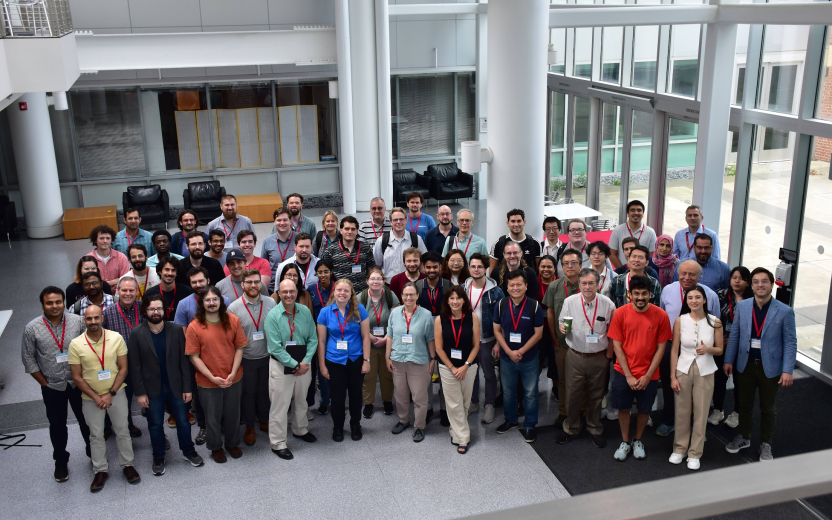
The workshop was designed to strengthen connections across disciplines—linking accelerator physics, materials science, and engineering—and to mentor the next generation of researchers. Discussion focused on three key areas that have been central to CBB’s research:
- Photocathodes that enable high-brightness electron sources
- Superconducting RF (SRF) cavities that support high fields with low energy loss
- Normal-conducting RF (NCRF) structures for compact, high-gradient accelerators
Highlights from the Discussions
Talks and breakout sessions showcased new approaches in epitaxial photocathodes, including ultra-thin alkali antimonide and telluride films with improved quantum efficiency and durability. Researchers also shared progress on protective coatings and spin-polarized cathodes that could extend cathode lifetimes and enable new applications.
In the SRF materials sessions, participants discussed ongoing efforts to better understand how impurity control and surface composition affect performance in niobium and Nb₃Sn cavities. Presentations emphasized the importance of developing predictive, materials-based processing to achieve consistent, cost-effective results.
For NCRF structures, talks focused on understanding and mitigating RF breakdown, exploring materials optimization, cryogenic cooling, and advanced cavity designs such as distributed coupling to achieve higher accelerating gradients.
Looking Ahead
The workshop highlighted the strong momentum at the intersection of accelerator and materials research. Participants expressed broad support for continuing the Materials for Bright Beams series on a biennial schedule, ensuring sustained collaboration among universities, national labs, and industry partners as CBB concludes its NSF support in 2026 and new initiatives take shape.
Organizing Committee
- Shreyas Balachandran, Florida State U.
- Bruce Carlsten, LANL
- Caterina Cocchi, Jena U.
- Lance Cooley, Florida State U. *
- Grigory Eremeev, FNAL
- Alice Galdi, UNISA
- Alex Gurevich, Old Dominion U.
- Siddharth Karkare, Arizona State U.
- Matthias Liepe, Cornell U. *
- Jared Maxson, Cornell U.
- Ritchie Patterson, Cornell U. *
- Danny Perez, LANL
- John Power, ANL
- Jamie Rosenzweig, UCLA *
- Steve Sibener, U. of Chicago
- John Smedley, SLAC
- Sami Tantawi, Arizona State U.
- Anne-Marie Valente-Feliciano, JLab